
 Tiếng Việt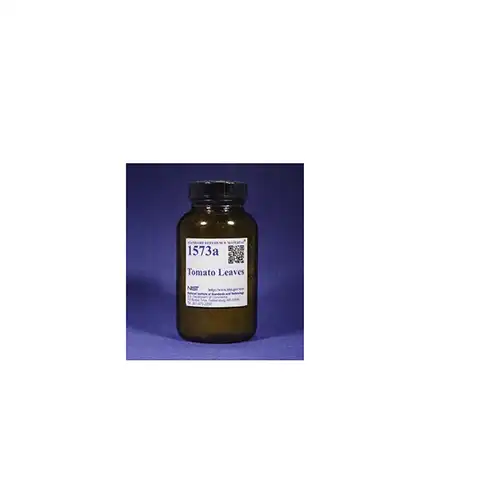
Application
Tomato leaves has been used as a standard reference material
in evaluating the cloud-point extraction methodology for copper and nickel determination in food samples[1]
for determining the precision of energy dispersive X-ray fluorescence spectrometry (EDXRF) method for nutrient analysis[2]
in evaluating the accuracy of high resolution continuum source flame molecular absorption spectrometry (HR-CS-FMAS) for determination of sulfur in food[3]
for evaluating the accuracy of thermospray flame furnace atomic absorption spectrometer (TS-FF-AAS) in cobalt determination in biological materials[4]
Biochem/physiol Actions
Tomato leaves is rich in calcium, magnesium, potassium and phosphorus.[5][6] Other minor nutrients present in leaves includes sulfur, boron, manganese, iron, copper, zinc and molybdenum. All these nutrients constitute for the macromolecules like protein and nucleic acid. Also, helps in regulating the enzymatic activity of the plant, and for normal growth and reproduction.[6]
General description
SRM 1573A_cert
SRM 1573A_SDS
Other Notes
Certified for the analytes listed below. See certificate for values and more details
Kjeldahl Nitrogen, Nitrogen (Total), Phosphorus
Trace Elements: Aluminum (Al), Antimony (SB), Arsenic (As), Barium (Ba), Boron (B), Bromine (Br), Cadmium (Cd), Calcium (Ca), Cesium (Cs), Chlorine (Cl2), Chromium (Cr), Cobalt (Co), Copper (Cu), Gadolinium (Gd), Hafnium (Hf), Hydrogen (H), Iodine (I), Iron (Fe), Lanthanum (La), Magnesium (Mg), Manganese (Mn), Mercury (Hg), Molybdenum (Mo), Nickel (Ni), Potassium (K), Rubidium (Rb), Samarium (Sm), Scandium (Sc), Selenium (Se), Silver (Ag), Sodium (Na), Strontium (Sr), Sulfur (S), Thorium (Th), Uranium (U), Vanadium (V), Zinc (Zn)
Matrix Group: Fruits and Vegetables
Legal Information
NIST is a registered trademark of National Institute of Standards and Technology
SRM is a registered trademark of National Institute of Standards and Technology