
 Tiếng Việt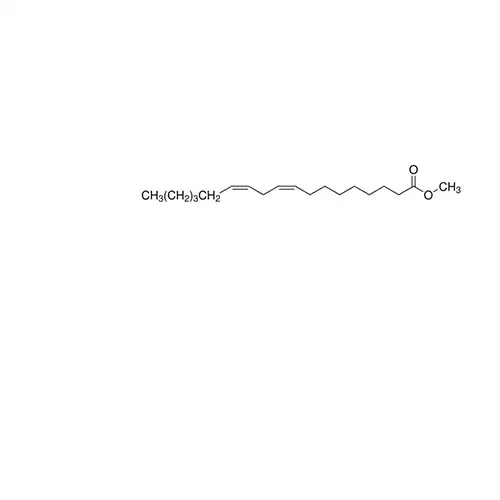
Application
The oxidation of methyl linoleate in organic solution and phosphatidylcholine (PC) in liposomal membranes induced by an azo initiator has often been used as a model for lipid peroxidation in vivo [1].
This analytical standard can also be used as follows:
Comparative analysis of gas chromatography-combustion-mass spectrometry and gas chromatography-flame ionization detector methods for the determination of fatty acid methyl esters (FAMEs) in biodiesel samples
Gas chromatography-tandem differential mobility spectrometry (DMS) based separation and quantification of 16 methyl- and ethyl- fatty acid esters from biodiesel samples
Simultaneous determination of fatty acid methyl esters in commercial food oil samples by gas chromatography-vacuum ultraviolet (GC-VUV) spectroscopy
Measurement of fatty acid methyl ester composition of various edible oil samples by 1H nuclear magnetic resonance (1H NMR) spectroscopy combined with partial least squares (PLS) method
Analysis of coffee oil and residue obtained from roasted coffee beans to determine the composition of 11 fatty acids following their methyl esterification by gas chromatography coupled with a flame ionization detector (GC-FID)
Simultaneous determination of fatty acids in bovine colostrum samples by GC-FID after their derivatization to ester forms using an acidic catalyst boron trifluoride
General description
Methyl linoleate is a methyl ester of the tri-unsaturated essential fatty acid, linoleic acid.
Methyl linoleate, non-conjugated, is more easily oxidized than conjugated methyl linoleate [2].
Other Notes
Refer to the product′s Certificate of Analysis for more information on a suitable instrument technique. Contact Technical Service for further support.