
 Tiếng Việt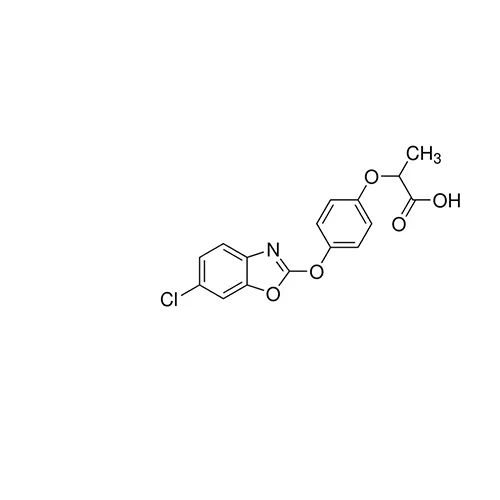
General description
Fenoxaprop is the chiral metabolite formed due to the degradation of its parent compound – Fenoxaprop-ethyl, in soil. Fenoxaprop belongs to the group of aryloxyphenoxypropionate (APP) herbicides and has been used widely for the selective postemergence control of annual and perennial grass weeds in broadleaf crops. This systemic herbicide is primarily absorbed by leaves, translocated both acropetally and basipetally in the phloem and xylem to roots or rhizomes. Fenoxaprop acts by inhibiting acetyl CoA carboxylase (ACCase) – a key enzyme in lipid biosynthesis and blocks the production of phospholipids used in building new membranes.
According to Commission Regulation (1107/2009), fenoxaprop is not approved for use as a plant protection product in the European Union. However, a default MRL of 0.01 mg/kg is set according to Art 18(1)(b) Reg 396 / 2005.
Application
Refer to the product′s Certificate of Analysis for more information on a suitable instrument technique. Contact Technical Service for further support. The analytical standard (Pestanal) can be used to:
Develop an HPLC method for the determination of fenoxaprop-ethyl and fenoxaprop residues in four soil types using two extraction procedures
Validate the resistance of fenoxaprop in wild oats in Turkey and investigate cross and multiple resistance patterns of fenoxaprop-resistant wild oat populations
Investigate the degradation of fenoxaprop-ethyl and fenoxaprop in three soils were under native and sterilized conditions using enantioselective high-performance liquid chromatography (HPLC)
Determine the effect of soil moisture, temperature, and light intensity on the spray deposition of fenoxaprop and imazamethabenz applied to wild oat plants
Investigate and quantify the resistance of Japanese foxtail (Alopecurus japonicus) to fenoxaprop and pinoxaden in China and elucidate the basis of resistance to these herbicides
Legal Information
PESTANAL is a registered trademark of Merck KGaA, Darmstadt, Germany