
 Tiếng Việt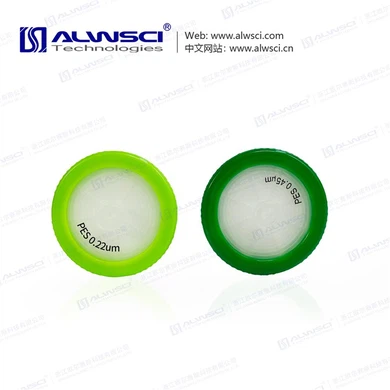
1) Description
PES (polyethersulfone) syringe filters with hydrophilic membrane and strong mechanical strength for reliable routine use.
Ideally suited for aqueous solutions, buffers and mid-polar liquids where high flow rate and low protein binding are required.
Commonly used for tissue culture media, biological samples, and analytical sample preparation.
Available pore sizes: 0.22 μm and 0.45 μm
Available diameters: 13 mm, 25 mm and 33 mm
2)Features
▶ Hydrophilic PES membrane with excellent flow rate for aqueous and low-viscosity samples
▶ High mechanical and thermal stability for consistent filtration performance
▶ Low protein binding, recommended for protein- and peptide-containing samples
▶ Symmetric membrane structure supports high throughput and shorter filtration time
▶ Low extractable levels, making it suitable for environmental and analytical testing
3) Application
◆ Filtration of tissue culture media, buffers and salt-containing solutions
◆ Sample preparation for proteins and nucleic acids with low protein adsorption
◆ Clarification of aqueous solutions with high throughput requirements
◆ Suitable for environmental, biological and general laboratory analysis
◆ Often used for applications including ion chromatography and bio-analytical workflows
4) How to choose filter size?
0–1 mL → use 4 mm syringe filters (typical hold-up volume < 10 μL)
0–10 mL → use 13 mm syringe filters (typical hold-up volume < 25 μL)
10–100 mL → use 25 mm syringe filters (typical hold-up volume < 100 μL)
10–150 mL → use 33 mm syringe filters (typical hold-up volume < 125 μL)
5) FAQ
Q1: What are PES syringe filters mainly used for?
PES syringe filters are mainly used for aqueous solutions, tissue culture media, buffers and biological samples, especially where high flow rate and low protein binding are required.
Q2: Are PES syringe filters suitable for protein samples?
Yes. PES has low protein adsorption, making it a good choice for filtering proteins, peptides and other biological macromolecules when high recovery is desired.
Q3: Can PES syringe filters be used with organic solvents?
PES is primarily designed for aqueous and mild organic solutions. It has good chemical resistance to many water-miscible solvents, but is not recommended for very strong or highly non-polar organic solvents where PTFE may be more suitable.
Q4: Are PES membranes hydrophilic or hydrophobic?
PES membranes are naturally hydrophilic, so they are easily wetted by water and provide fast flow for aqueous samples without pre-wetting.
Q5: What pore size should I choose: 0.22 μm or 0.45 μm?
- 0.22 μm → for sterilizing filtration and fine particulate removal
- 0.45 μm → for routine clarification of samples with moderate particle load
For sterile or critical biological applications, 0.22 μm is usually recommended.
Q6: Are PES syringe filters suitable for ion chromatography?
Yes. Low extractable levels and good chemical compatibility make PES suitable for many ion chromatography applications, especially when filtering aqueous salt solutions and buffers.
Q7: Can PES syringe filters be used for sterilizing filtration?
Yes, 0.22 μm PES syringe filters are commonly used for sterilizing or clarifying biological solutions such as media and buffers, provided they are used under appropriate sterile handling conditions.