
 Tiếng Việt
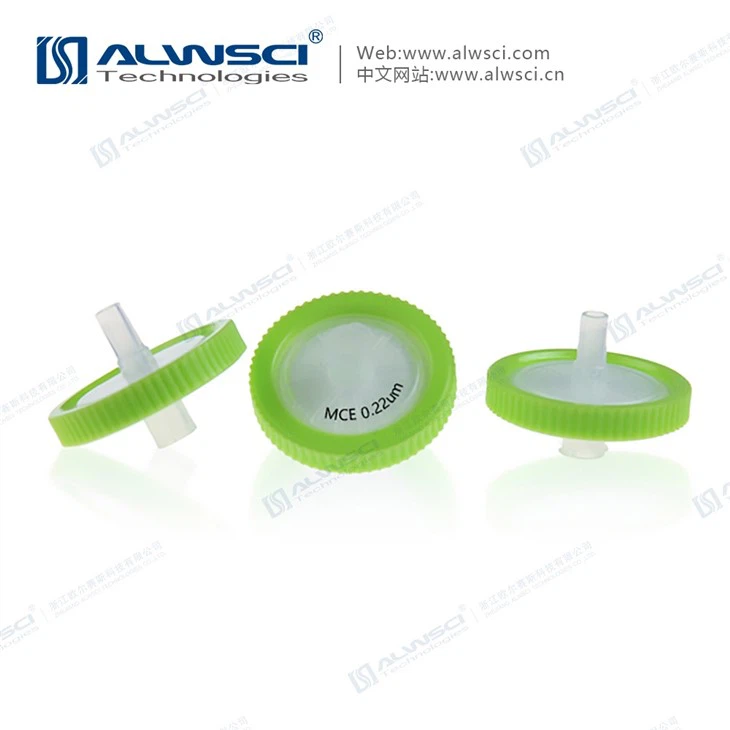
1) Description
Economy MCE (Mixed Cellulose Ester) Non-Sterile Syringe Filters use a hydrophilic mixed cellulose ester membrane, offering fast flow rates and good retention for aqueous samples.
MCE membranes are widely used in analytical and routine laboratory filtration thanks to their biocompatibility, low extractables and uniform pore structure.
They are suitable for clarification of buffers, water samples and many biological or environmental solutions.
2)Features
Hydrophilic mixed cellulose ester membrane with fast flow and efficient particle retention.
Biocompatible and suitable for many biological and environmental applications.
Uniform microporous structure provides consistent filtration performance.
Low extractable levels help maintain analytical accuracy.
Suitable for a wide range of aqueous solutions and some water-miscible solvents.
3) Application
◆ Laboratory: In the laboratory, Economy MCE Non-Sterile Syringe Filter can be used for experimental operations such as filtering solutions, cleaning reagents, and separating cells.
◆ Industrial Production: In industrial production, this filter can be used in processes such as preparing high-purity liquids, cleaning process liquids, and removing impurities.
◆ Medical Field: In the medical field, Economy MCE Non-Sterile Syringe Filter can be used for medical operations such as infusion, injection, and drug preparation
◆ Microbiological and environmental testing: suitable for capturing and retaining microorganisms and particles in water and wastewater samples.
◆ General-purpose filtration: removal of particulates from various low-viscosity aqueous solutions in research and quality control labs.
4) How to choose filter size?
0-1mL Sample Volume uses 4mm Syringe Filters with a hold-up volume of less than 10μL.
0-10mL Sample Volume uses 13mm Syringe Filters with a hold-up volume of less than 25μL.
10-100mL Sample Volume uses 25mm Syringe Filters with a hold-up volume of less than 100μL.
10-150mL Sample Volume uses 33mm Syringe Filters with a hold-up volume of less than 125μL.
5) FAQ
Q1: What are MCE syringe filters mainly used for?
MCE syringe filters are mainly used for aqueous solutions, buffers and environmental water samples, especially in routine lab and microbiological workflows.
Q2: Are MCE membranes hydrophilic or hydrophobic?
MCE membranes are hydrophilic, so they are easily wetted by water and provide fast flow for aqueous samples without pre-wetting.
Q3: Can MCE syringe filters be used for strong organic solvents?
No. MCE is primarily designed for aqueous solutions and some water-miscible solvents.
For strong or highly non-polar organic solvents, PTFE or PVDF syringe filters are usually recommended.
Q4: Are MCE syringe filters suitable for microbiological or environmental testing?
Yes. MCE membranes are commonly used to capture and retain microorganisms and particles in water and wastewater, making them suitable for many microbiological and environmental applications.
Q5: Are MCE filters low protein binding?
MCE has moderate protein binding.
If maximum protein recovery is required, PES or hydrophilic PVDF is usually preferred.
Q6: What pore size should I choose for MCE syringe filters?
- 0.22 μm → for finer particulate removal and higher clarity
- 0.45 μm → for routine clarification and less demanding filtration tasks
Q7: Can MCE syringe filters be used for sterilizing filtration?
Non-sterile MCE syringe filters can be used for general clarification.
For true sterilizing filtration, 0.22 μm sterile-grade filters (often PES or PVDF) are more commonly used and should be chosen according to application requirements.