
 Tiếng Việt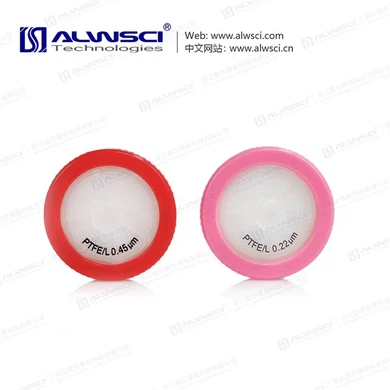
1) Description
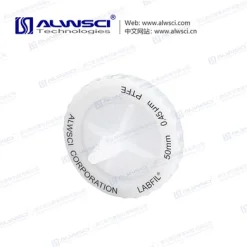
Hydrophobic PTFE syringe filters with broad chemical compatibility and excellent resistance to strong acids, bases and aggressive organic solvents.
Ideally suited for HPLC sample preparation, organic analysis and filtration of corrosive chemical solutions.
Hydrophilic PTFE options are also available through surface modification, offering strong affinity for water and rapid wetting.
PTFE membranes provide high mechanical strength, low extractables and consistent flow rates, ensuring reliable filtration performance.
Available pore sizes: 0.22 μm / 0.45 μm
Available diameters: 13 mm / 25 mm / 33 mm
2)Features
▶ Hydrophobic PTFE membrane with outstanding temperature and chemical resistance
▶ Compatible with solvents, gases, strong acids and bases
▶ Excellent filtration performance with very low extractables (IC-friendly)
▶ Maintains integrity with harsh chemicals-ideal for samples that may damage other membrane types
▶ Available in hydrophilic PTFE option for direct aqueous filtration
▶ Low protein binding and stable flow characteristics
3) Application
◆ Clarification and degassing of aqueous and organic samples
◆ Filtration of strong acids, alkalis and aggressive solvents
◆ Removal of particulates before HPLC/GC analysis
◆ Suitable for biofuel analysis, industrial chromatography and general laboratory chemical filtration
◆ Ideal for filtering corrosive chemicals, aerosols, gases and solvent-based solutions
4) How to choose filter size?
0–1 mL sample volume → 4 mm syringe filters (hold-up volume < 10 μL)
0–10 mL sample volume → 13 mm syringe filters (hold-up volume < 25 μL)
10–100 mL sample volume → 25 mm syringe filters (hold-up volume < 100 μL)
10–150 mL sample volume → 33 mm syringe filters (hold-up volume < 125 μL)
5)FAQ
Q1: What is the difference between hydrophobic and hydrophilic PTFE syringe filters?
Hydrophobic PTFE is ideal for aggressive organic solvents, strong acids, bases, and gases.
Hydrophilic PTFE is surface-modified to improve water wetting and is suitable for direct filtration of aqueous solutions.
If you need to filter pure water or buffer, hydrophilic PTFE is recommended.
Q2: Can PTFE syringe filters be used for strong acids and alkalis?
Yes. PTFE has excellent chemical resistance and is compatible with strong acids (HCl, HNO₃, H₂SO₄), strong bases (NaOH, KOH), and most corrosive chemicals.
This makes PTFE the preferred membrane for harsh samples that other membranes cannot tolerate.
Q3: Are PTFE syringe filters suitable for HPLC or LC-MS sample preparation?
Yes. PTFE filters are commonly used for HPLC/GC sample clarification, especially for organic or corrosive solvents.
For LC-MS applications requiring ultra-low extractables, use IC/LC-MS grade PTFE to minimize background noise.
Q4: Can PTFE syringe filters be used for protein or biological samples?
Not recommended.
PTFE membranes are hydrophobic and can cause poor wetting with aqueous biological solutions, and may lead to protein adsorption.
For protein-containing samples, PES or PVDF membranes are usually preferred.
Q5: Why do aqueous solutions sometimes not pass through hydrophobic PTFE?
Because PTFE is naturally hydrophobic.
If filtering water, buffers or polar liquids, you need to:
- Pre-wet with ethanol/methanol (optional), or
- Select hydrophilic PTFE, or
- Choose other hydrophilic membranes (Nylon, PES, MCE, PVDF)
Q6: What pore size should I choose: 0.22 μm or 0.45 μm?
- 0.22 μm → for fine particle removal, microbiological clarity, and cleaner HPLC samples
- 0.45 μm → for routine filtration of solutions with moderate particle load
If you are preparing samples for analytical instruments (HPLC/GC), 0.22 μm is usually recommended.
Q7: Are PTFE syringe filters compatible with gas or air venting applications?
Yes.
Hydrophobic PTFE is ideal for aerosol sampling, gas filtration, and venting applications, because the membrane does not allow liquid to pass through while allowing air and gases to flow freely.
Q8: Do PTFE syringe filters have a temperature limit?
Yes. PTFE membranes have excellent temperature resistance and can generally withstand higher temperatures than other membranes.
Typical operating limits depend on housing (PP), but PTFE itself is stable over a wide temperature range.
For high-temperature filtration, avoid exceeding the PP housing limit (~100°C).