
 Tiếng Việt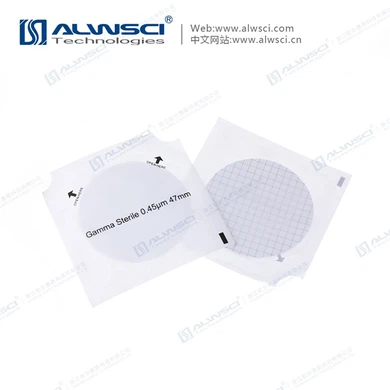
1) Description
Grid Membrane Filters are available in MCE (Mixed Cellulose Ester), CA (Cellulose Acetate), and CN (Cellulose Nitrate) materials, with 47mm diameter and a range of pore sizes such as 0.22µm and 0.45µm.
The clearly printed grid pattern improves colony visibility and supports accurate microbial enumeration during membrane filtration tests.
All membrane types are hydrophilic, allowing smooth passage of water and aqueous samples without sample loss. Sterile and non-sterile options are provided to meet different microbial testing and quality assurance requirements across laboratories and industrial environments.
2)Features
▶ Available in MCE, CA, and CN materials to meet different testing requirements
▶ Clear grid pattern enhances colony visibility and accurate counting
▶ Hydrophilic membranes ensure smooth filtration of aqueous samples
▶ 47mm diameter with pore sizes 0.22µm / 0.45µm (custom sizes available)
▶ Sterile (gamma-irradiated) and non-sterile options for diverse laboratory protocols
▶ High batch consistency and uniform pore size distribution for reliable test results
▶ Ideal for microbiology, environmental testing, food analysis, and pharmaceutical QC
▶ OEM/ODM services: customizable packaging, labeling, and bulk supply
3) Application
Grid Membrane Filters are widely used in:
- Microbiological analysis (bacteria enumeration, colony counting)
- Water and wastewater monitoring (drinking water, environmental testing)
- Food & beverage laboratory QC
- Pharmaceutical microbial limit tests and aseptic monitoring
- Air monitoring and environmental microbiology
- Particulate contamination inspection for oils and hydraulic fluids (patch test)
PS:
MCE → Best for general microbiological testing (high flow rate, uniform pore structure)
CA → Low protein binding, suitable for biological/serum filtration
CN → Fast flow rate, excellent for microbial recovery and colony growth
4) FAQ
1. What is a gridded membrane filter?
A gridded membrane filter is a hydrophilic membrane with a clearly printed grid pattern used for microbiological colony counting during membrane filtration. It is commonly made of MCE, CA, or CN and available in 47mm with pore sizes such as 0.22µm and 0.45µm.
2. What is the purpose of the grid on a membrane filter?
The printed grid helps increase colony visibility, making microbial enumeration easier and more accurate. It supports standardized microbiological analysis according to ISO and regulatory guidelines.
3. What is the difference between MCE, CA, and CN gridded membranes?
MCE (Mixed Cellulose Ester): Best for general microbiology, high flow rate, uniform pores.
CA (Cellulose Acetate): Low protein binding; ideal for biological and pharmaceutical samples.
CN (Cellulose Nitrate): Fast flow rate and excellent recovery of microorganisms.
4. When should I use 0.22µm vs. 0.45µm pore sizes?
0.22µm: For bacteria retention in sterile filtration and pharmaceutical QC.
0.45µm: Standard for microbial colony counting in water, wastewater, food, and beverage testing.
5. Are gridded membrane filters sterile?
They are available in both sterile (irradiation) and non-sterile versions. Sterile membranes are used for microbial testing requiring aseptic conditions.
6. What sample types can be filtered using gridded membranes?
Typical samples include drinking water, environmental water, wastewater, food extracts, beverages, pharmaceutical solutions, and biological liquids.
7. What is the standard diameter of gridded membrane filters?
The industry standard is 47mm, widely used in membrane filtration units and microbiology testing protocols.
8. How should gridded membranes be stored?
Store at room temperature in a dry, clean environment. Sterile membranes must remain sealed until use to maintain sterility.
9. Can gridded membranes be used with all filtration units?
Yes. 47mm gridded membranes are compatible with standard microbiological filtration holders, vacuum manifolds, and funnel systems used in laboratories worldwide.