
 Tiếng Việt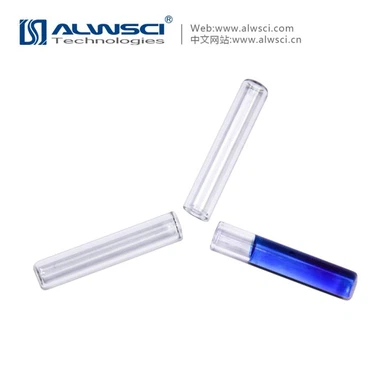
1) Description
Micro insert bottles are available in glass and polypropylene materials.
- Glass: Provides excellent chemical inertness and stability, suitable for most organic solvents and acidic and alkaline solutions. Glass vials are particularly useful for samples that may react with plastics. The glass is also transparent, making it easy to observe the sample.
- Polypropylene (PP): Provides good chemical compatibility, is lightweight, and has good shatter resistance, making it suitable for high-throughput sample processing and storage. PP material is particularly suitable for biological samples or those that are sensitive to glass.
A variety of styles are also available, including Flat base, Conical base, Conical base with Polyspring, and Conical base with Polyspring on the micro insert body with Graduation. Can meet different experimental needs.
2) Features
▶ Flat Base Design: Provides stable vertical performance and fits most standard autosamplers. The flat base design facilitates even distribution of samples, especially for solid or semi-solid samples.
▶ Guided sample transfer: The inner cannula ensures that the autosampler needle can accurately reach the sample in the vial, helping to reduce sample loss and cross-contamination.
▶ Limit Evaporation: Some inserts are designed with special sealing systems that can reduce sample evaporation, especially when handling volatile samples such as volatile organic compounds (VOCs).
▶ Precise Sampling Volume: By precisely controlling the depth of the needle’s reach, the inner cannula helps achieve a constant volume of sample from the injection bottle, thereby improving the accuracy and repeatability of the analysis.
▶ Adapt to Different Types of Samples: The inner insert tube can be specially designed according to the properties of the sample (such as viscosity, volatility, etc.) to adapt to a wide range of analysis needs.
▶ Compatibility: Designed for use with specific models of autosamplers and analytical instruments to ensure overall system performance.
3) Application
- Improve Sample Recovery Rate
Volatile sample analysis: When analyzing volatile organic compounds (VOCs), the inner insert tube can reduce the evaporation loss of the sample during the injection process, ensuring a higher sample recovery rate, thereby improving the accuracy of the analysis results.
- Reduce Cross-contamination
Rapid analysis of multiple samples: In high-throughput sample analysis, such as environmental monitoring or food safety testing, the inner insert tube can ensure effective isolation of the needle and sample after each injection, reducing the risk of cross-contamination.
- Precisely Control Sample Volume
Quantitative analysis: In applications that require precise quantification of component content, such as drug content determination, the inner cannula helps obtain a constant volume of sample from the injection bottle by precisely controlling the depth of the injection needle, thereby improving the accuracy of analysis. sex and repeatability.
- Adapt to samples in different physical states
Handling viscous or semi-solid samples: The specially designed inner tube can be adapted to the injection of viscous or semi-solid samples, such as honey or oil analysis, ensuring that the sample can enter the analysis instrument smoothly.
- Compatibility and applicability
Special sample processing: For some samples that require special processing, such as biological samples or samples containing suspended particles, the design of the inner tube can be adjusted according to the characteristics of the sample to optimize sample injection and analysis.
- Automation and high efficiency
Automated sample pre-processing: In automated sample pre-processing, the inner insert tube can be used in conjunction with the automatic sampling system to achieve automatic dilution, mixing or spiking of samples, improving experimental efficiency and accuracy.