
 English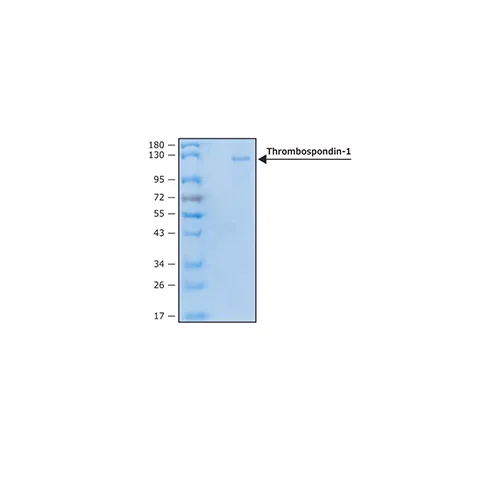
General description
Thrombospondin-1 (TSP1) belongs to family of glycoproteins [1] and possesses a complex trimeric structure. The structure comprises a heparin-binding domain and a procollagen homology domain located at the amino terminus, while the carboxyl-terminal end contains type I, II, and III repeats. [2] This protein is manufactured in human cells using an all-human production system, with no serum. The human cells expression system allows human-like glycosylation and folding, and often supports better stability of the protein in culture. Recombinant human thrombospondin-1 is expressed in HEK293 cells as a glycoprotein with a calculated moleculaer mass of 127.5 kDa.
Application
Thrombospondin 1 human (TSP1) has been used:
To treat hepatocyte (IHH) cancer cells to study the role of aspartyl protease 1 (MfSAP1) in extracellular matrix degradation. [3]
In in vitro Extracellular Matrix (ECM) protein degradation assays. [4]
In rat C6 astroglioma cells, for coating the cell culture plates to study the effects of integrins on CNTF (ciliary neurotrophic factor) expression.
In the preparation of secreted factor cocktail for analysis of the human mesenchymal stem cell secretome.
Recommended for use as a cell culture substratum at 1-5 μg/cm2 or 0.1-25 μg/ml. Optimal concentration depends on cell type as well as the application or research objectives.
Biochem/physiol Actions
Thrombospondin (TSP1) plays a crucial role in guiding extracellular matrix (ECM) synthesis and facilitating dynamic tissue remodeling. It is involved in various biological processes including angiogenesis, matrix assembly, activation of transforming growth factor (TGF), and promotion of neurite outgrowth. [2] TSP1 binds to various cell surface receptors, such as integrins and integrin-associated protein CD47. [1] Studies have also shown that the signaling pathway involving TSP1-CD47 promotes the generation of reactive oxygen species (ROS) in human pulmonary artery endothelial cells. This signaling pathway plays a significant role in the manifestation of sickle cell-associated vasculopathy and the subsequent progression of pulmonary hypertension. [1] Moreover, hypoxia-inducible factor (HIF)-2α has been shown to upregulate the expression of TSP1 under hypoxic conditions. [1] TSP1 also plays a crucial role in inflammatory processes and post-inflammatory tissue dynamics. [5] It is upregulated in rheumatoid synovial tissues and might be associated with rheumatoid arthritis. [6]
Features and Benefits
Human-derived thrombospondin
Produced through recombinant expression in HEK 293 cells
Low endotoxin levels
Physical form
Supplied as a powder, lyophilized from phosphate buffered saline.
Analysis Note
The biological activity of recombinant human thrombospondin-1 was tested in culture by measuring the ability of immobilized DTT-treated thrombospondin-1 to support adhesion of SVEC4-10 cells.