
 English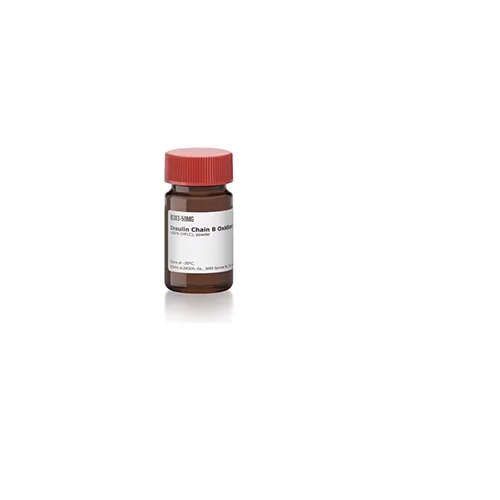
General description
Insulin is made up of two polypeptide chains (A and B) linked together by two disulfide linkages. Chain A and B are composed of 21 amino acids and 30 amino acids, respectively.[1]
Application
Insulin Chain B Oxidized from bovine pancreas has been used:
as a matrix-assisted laser desorption/ionization (MALDI)-mass spectrometry (MS) calibration standard[2][3]
in electrochemical impedance spectroscopy and quartz crystal nanobalance (EQCN) studies of insulin adsorption on platinum[1]
as an internal standard to quantify insulin chain B residue in protein samples[4]
Biochem/physiol Actions
Insulin regulates the cellular uptake, utilization, and storage of glucose, amino acids, and fatty acids. It inhibits the breakdown of glycogen, protein, and fat. The β chain is a substrate for carboxypeptidase Y.
Preparation Note
Prepared by modification of Sanger, F., et al.