
 English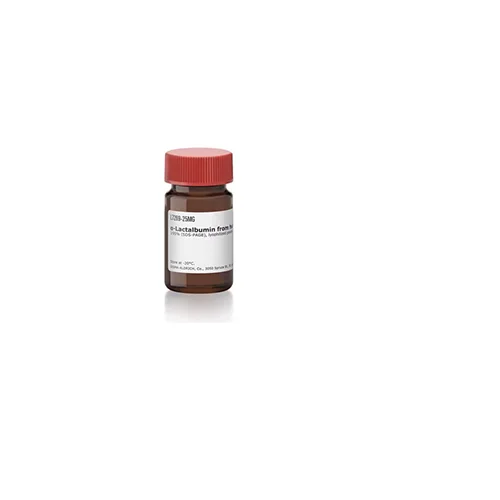
General description
α-Lactalbumin (α-LA) is a small, acidic,[1] whey protein that constitutes about 22% of the total proteins in human milk.[2] It is produced by the epithelial cells of the mammary gland. α-LA is made up of two domains, a large α-helical domain, and a small β-sheet domain.[1]
Application
α-Lactalbumin (α-LA) has been used as a standard
to study the partitioning behavior of different monomeric proteins with exposure to amino acids on the protein surface[3]
to study the interaction between α-LA and cathepsin D[4]
to study the ability of breast milk fractions to enhance the transepithelial flux of extrinsic iron in colon carcinoma cell line
Biochem/physiol Actions
α-Lactalbumin (α-LA) forms a complex with lactose synthase within the mammary gland and plays a role in milk production and regulates milk volume. It acts as an essential source for bioactive peptides and essential amino acids such as lysine, tryptophan, branched-chain amino acids, and sulfur-containing amino acids that play a role in an infant′s nutrition. In addition, α-LA has a wide range of applications including a supplement to foster gastrointestinal health and modulate sleep and depression. α-LA also shows therapeutic effects against sarcopenia, seizures, mood disorders, and cancer.[2] It has a Ca2+ binding site that binds with Na+, K+, Mg2+, and Mn2+ and many Zn2+ binding sites.[1]
Alters the substrate specificity of galactosyltransferase to increase the rate of lactose formation; the complex of galactosyltransferase and α-lactalbumin is called lactose synthase.
Alters the substrate specificity of galactosyltransferase to increase the rate of lactose formation; the complex of galactosyltransferase and α-lactalbumin is called lactose synthase. Complexes of α-lactalbumin with oleic acid show drastically different activities than α-lactalbumin alone, being strongly cytotoxic to tumor cells. The complex is referred to as HAMLET (human alpha-lactalbumin made lethal to tumor cells).