
 English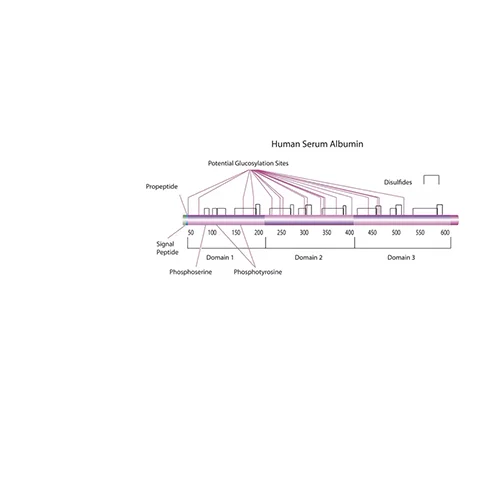
General description
Albumin is the most copious protein in blood plasma. Produced in the liver,[1] serum albumin serves as a carrier protein for biomolecules like as fatty acids, amino acids, and steroids.
This human serum albumin (HSA) product has been specially tested and evaluated to be low in the following properties:
Essentially protease-free / low protease content
Low alkaline phosphatase content
Low peroxidase content
Serum albumin is used in various applications related to molecular biology, notably as an inert protein stabilizer for stock solutions of enzymes and proteins of interest. In such applications, it is thus important for the HSA to be protease free, to maintain the integrity of the protein or enzyme of interest.
Protease-free HSA is especially useful for applications like:
Enzyme assays
Protein-based assays
Protease-sensitive techniques such as:
(a) Enzyme immunoassay (EIA)
(b) Nucleic acid hybridization
(c) Radioimmunoassay (RIA)
Application
Albumin was used to test its effect on the in vitro bactericidal activity of cefditoren against penicillin-resistant Streptococcus pneumonia.[2] It has been clinically used in serious and often life-threatening conditions, such as shock and blood loss due to trauma, burns, and surgery.[1]
It was used to test the effect of non-enzymatic glycation on the unfolding of human serum albumin.[3] It was also used to test the two distinct pathways used by intestinal epithelial cells for HLA class II antigen processing.[4]
Biochem/physiol Actions
Albumins are soluble monomeric proteins found in the body fluids and tissues of animals and in some plant seeds. Serum albumin functions as a carrier protein for steroids, fatty acids, and thyroid hormones. Serum albumins are also vital in regulating the colloidal osmotic pressures of blood.
Serum albumin functions as a carrier protein for steroids, fatty acids, and thyroid hormones, and is vital in regulating the colloidal osmotic pressures of blood. Albumin is also seen to bind to exogenous substances, particularly drugs (e.g., ibuprofen, warfarin), and strongly influence their pharmacokinetics. Oxidative stress leading to changes in the redox state of albumin has widely varied effects on its physiological function.
Features and Benefits
Low protease activity / essentially protease-free (≤ 0.0001 units/mg protein)
Low alkaline phosphatase activity (≤ 0.001 units/mg protein)
Low peroxidase activity (≤ 0.001 units/mg protein)
Preparation Note
Prepared from A1653
Other Notes
View more information on human serum albumin.
Disclaimer
RESEARCH USE ONLY. This product is regulated in France when intended to be used for scientific purposes, including for import and export activities (Article L 1211-1 paragraph 2 of the Public Health Code). The purchaser (i.e. enduser) is required to obtain an import authorization from the France Ministry of Research referred in the Article L1245-5-1 II. of Public Health Code. By ordering this product, you are confirming that you have obtained the proper import authorization.