

 English
Application
Tumor Necrosis Factor-α from mouse, a potent proinflammatory cytokine has been used:
to activate MS1 endothelium cells[1]
to induce lipolysis in adipocytes[2]
to study its effect on liganded and unliganded glucocorticoid receptor (GR) in interleukin (IL)-6 and IL-8 gene regulation[3]
Biochem/physiol Actions
Tumor necrosis factor-α (TNF-α), also known as cachectin, is expressed as a 26 kDa membrane bound protein and is then cleaved by TNF-α converting enzyme (TACE) to release the soluble 17 kDa monomer, which forms homotrimers in circulation. TNF-α plays roles in antitumor activity, immune modulation, inflammation, anorexia, cachexia, septic shock, viral replication and hematopoiesis. TNF-α is expressed by a great variety of cells, with numerous inductive and suppressive agents. Primarily, TNF-α is produced by macrophages in response to immunological challenges such as bacteria (lipopolysaccharides), viruses, parasites, mitogens and other cytokines. TNF-α is cytotoxic for many transformed cells (its namesake activity) but in normal diploid cells, it can stimulate proliferation (fibroblasts), differentiation (myeloid cells) or activation (neutrophils). TNF-α also shows antiviral effects against both DNA and RNA viruses and it induces production of several other cytokines. Although TNF-α is used in clinical trials as an antitumor agent, Sigma′s cytokine, growth factor and hormone products are for research only. TNF-α and the related molecule TNF-β (LT-α) share close structural homology with 28% amino acid sequence identity and both activate the same TNF receptors, TNFR1 and TNFR2. Mouse and human TNF-α share 79% amino acid sequence identity. Unlike human TNF-α, the mouse form is glycosylated.
Tumor necrosis factor-α, also known as cachectin, is expressed as a 26 kDa membrane bound protein and is then cleaved by TNF-α converting enzyme (TACE) to release the soluble 17 kDa monomer, which forms homotrimers in circulation. TNF-α plays roles in antitumor activity, immune modulation, inflammation, anorexia, cachexia, septic shock, viral replication and hematopoiesis. TNF-α is cytotoxic for many transformed cells, but in normal diploid cells, it stimulates proliferation (fibroblasts), differentiation (myeloid cells) or activation (neutrophils). TNF-α also shows antiviral effects against both DNA and RNA viruses and induces production of several other cytokines.
Physical form
Lyophilized from 10 mM sodium phosphate, pH 7.5
Other Notes
2024 CiteAb Award Winner for Supplier Succeeding in Parkinson′s Research
One unit is the amount required to induce half-maximal cytolysis of L929 cells.
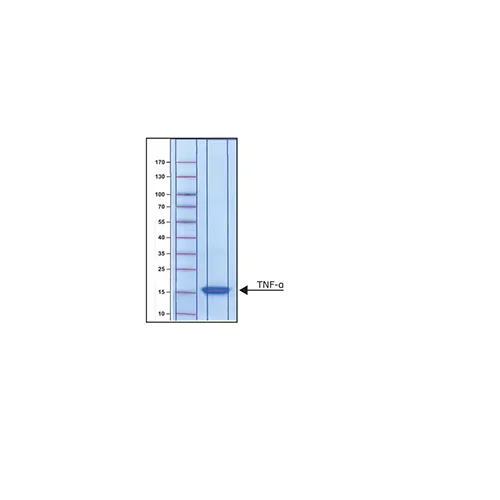
Tumor Necrosis Factor-α from mouse
≥95%, recombinant, expressed in E. coli, powder, suitable for cell culture
Code: T7539
- Hãng sản xuất: Merck
- Thương hiệu: Sigma-Aldrich
- Hãng sản xuất: Merck
| Hãng sản xuất |
|---|
Sản phẩm tương tự
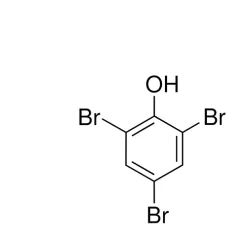
D-(+)-Glucose
powder, BioReagent, suitable for cell culture, suitable for insect cell culture, suitable for plant cell culture, ≥99.5%
Code: G7021
- Hãng sản xuất: Merck
- Thương hiệu: Sigma-Aldrich
DMEM – high glucose
With sodium Bicarbonate and ʟ-glutamine, without sodium pyruvate, liquid, sterile-filtered, suitable for cell culture
Code: D5796
- Hãng sản xuất: Merck
- Thương hiệu: Sigma-Aldrich
Fetal Bovine Serum
USA origin, sterile-filtered, suitable for cell culture, suitable for hybridoma
Code: F2442
- Hãng sản xuất: Merck
- Thương hiệu: Sigma-Aldrich
Dimethyl sulfoxide
sterile-filtered, BioPerformance Certified, meets EP, USP testing specifications, suitable for hybridoma
Code: D2438
- Hãng sản xuất: Merck
- Thương hiệu: Sigma-Aldrich
Fetal Bovine Serum
USDA approved, sterile-filtered, suitable for cell culture
Code: F0926
- Hãng sản xuất: Merck
- Thương hiệu: Sigma-Aldrich
Bovine Serum Albumin
heat shock fraction, protease free, fatty acid free, essentially globulin free, pH 7, ≥98%
Code: A703010 g A7030-10G
50 g A7030-50G
100 g A7030-100G
500 g A7030-500G
1 kg A7030-1KG
5 kg A7030-5KG
- Hãng sản xuất: Merck
- Thương hiệu: Sigma-Aldrich

Fetal Bovine Serum
USA origin, Heat Inactivated, sterile-filtered, suitable for cell culture, suitable for insect cell culture, suitable for hybridoma
Code: F4135
- Hãng sản xuất: Merck
- Thương hiệu: Sigma-Aldrich
RPMI-1640 Medium
With ʟ-glutamine, sodium bicarbonate, liquid, sterile-filtered, suitable for cell culture
Code: R8758100 mL R8758-100ML
500 mL R8758-500ML
1 L R8758-1L
6 x 500 mL R8758-6X500ML
6 x 1 L R8758-6X1L
24 x 500 mL R8758-24X500ML
- Hãng sản xuất: Merck
- Thương hiệu: Sigma-Aldrich
Dimethyl sulfoxide
≥99.5% (GC), suitable for plant cell culture
Code: D4540
- Hãng sản xuất: Merck
- Thương hiệu: Sigma-Aldrich

Minimum Essential Medium Eagle
With Earle′s salts, L-glutamine and sodium bicarbonate, liquid, sterile-filtered, suitable for cell culture
Code: M4655
- Hãng sản xuất: Merck
- Thương hiệu: Sigma-Aldrich

